
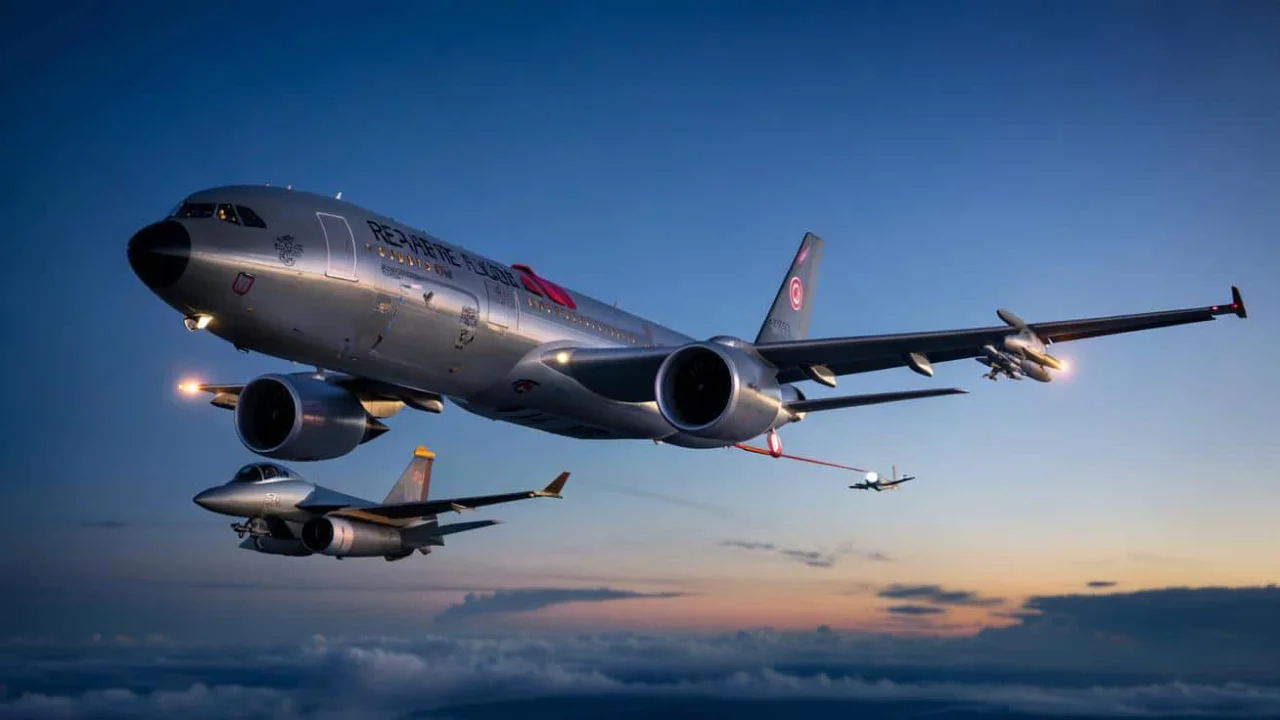
Combat aviation just crossed a historic threshold. On February 4, 2026, Singapore’s air force became the first military globally to deploy fully certified automatic airtoair refuelling technology during live operations. This Airbus-developed system transforms one of aviation’s most dangerous maneuvers into a computer-controlled process that could reshape how nations project air power across vast distances.
The implications extend far beyond Singapore’s borders. As geopolitical tensions mount and air forces stretch to patrol increasingly distant territories, this breakthrough offers a glimpse into combat aviation’s automated future.
Singapore’s Historic Refuelling Milestone at a Glance
| Achievement | Details |
|---|---|
| First Operational Deployment | February 4, 2026 – Singapore Air Force |
| Technology Provider | Airbus A3R (Automatic Air-to-Air Refuelling) |
| Aircraft Platform | A330 MRTT tanker fleet |
| Operational Speed | Over 800 km/h during refuelling |
| Certification Authority | Spanish aerospace institute INTA |
| Development Partnership | Singapore-Airbus collaboration since 2020 |
Critical Performance Metrics That Matter
| Capability | Traditional Manual | New A3R System |
|---|---|---|
| Contact Precision | Operator-dependent | Multiple adjustments per second |
| Weather Limitations | Severe in poor conditions | Enhanced turbulence management |
| Training Requirements | Intensive specialist programs | Reduced operator workload |
| Mission Duration | Limited by crew fatigue | Consistent performance over time |
| Data Collection | Basic logs | High-definition video and positioning data |
How Automated Systems Transform Military Refuelling Operations
Traditional mid-air refuelling demands extraordinary skill. Two aircraft flying meters apart at 800+ km/h must achieve precision connection, often in darkness or turbulent conditions. Human operators required years of training and nerves of steel to master boom control.
Airbus’s A3R system revolutionizes this process through smart cameras, onboard image processing, and guidance algorithms. The boom transforms from manually-controlled hardware into a supervised, largely automated system handling approach, alignment, and contact.
The technology manages subtle movements from turbulence, wake vortex, and pilot inputs automatically. Human operators monitor screens and retain instant override capability, but computers perform the detailed positioning work under normal conditions.
Key Automation Components
- Network of intelligent camera systems
- Real-time image processing algorithms
- Precision guidance software
- Automated boom positioning controls
- Continuous turbulence compensation
- Human oversight with instant manual override
Which Air Forces Stand to Benefit Most
Several categories of military operators gain significant advantages from automatic airtoair refuelling technology:
- Small High-Tech Forces: Nations like Singapore with limited assets covering large territories
- Extended Range Operators: Air forces conducting Indo-Pacific or Arctic patrols
- Coalition Partners: Allied nations requiring interoperability with multiple tanker types
- Training-Limited Services: Air forces facing specialist operator shortages
- 24/7 Mission Requirements: Forces maintaining continuous air surveillance
For Singapore specifically, every additional minute of fighter endurance proves crucial given the country’s strategic position and limited aircraft numbers.
“Automated refuelling represents a force multiplier for smaller air forces that can’t afford the luxury of extensive tanker fleets,” explains a defense aviation analyst familiar with Southeast Asian military procurement.
Immediate Operational Advantages for Combat Units
Military planners identify several practical benefits emerging from automated refuelling capabilities:
- Extended Mission Windows: Fighter patrols stay airborne longer with fewer tanker sorties required
- Predictable Timeline Management: Strike packages refuel multiple times with consistent scheduling
- Reduced Human Bottlenecks: Fewer specialist operators needed per mission
- Enhanced Data Collection: Precise logs on alignment, distance, and duration for every refuelling event
- Improved Night Operations: Computer vision excels in low-visibility conditions
- Consistent Performance: Hundredth contact maintains same precision as the first
Boeing’s KC-46A Pegasus Faces Automation Gap
Airbus’s achievement highlights growing competition disadvantages for Boeing’s KC-46A Pegasus tanker. While the American aircraft includes Automatic Boom Operator (ARO) system assistance, it lacks certified full automation capability.
The KC-46A’s ARO relies on high-definition 3D cameras and remote workstations, but boom movements still require manual operator control. Technical challenges continue plaguing the platform:
- Inconsistent 3D imagery affected by glare and lighting
- Restrictions on refuelling certain lighter aircraft
- Repeated delivery delays impacting export prospects
- No certified automatic operation capability
The US Air Force launched RVS 2.0 redesign targeting late 2025 deployment, but certified automatic airtoair refuelling remains unavailable on American platforms.
Comprehensive Tanker Platform Comparison
| Specification | Airbus A330 MRTT | Boeing KC-46A Pegasus |
|---|---|---|
| Base Aircraft | A330-200 widebody | Boeing 767-2C derivative |
| Fuel Capacity | ≈ 111 tonnes | ≈ 96 tonnes |
| Maximum Troop Seats | About 260 | Lower cabin capacity |
| Customer Base | 15+ countries, three continents | Primarily United States |
| Total Orders | About 75 aircraft | About 150 (mostly USAF) |
| Deliveries | 60+ in service | Dozens delivered |
| Automation Level | Fully certified automatic refuelling | Semi-automatic with manual control |
“The certification gap between European and American tanker automation represents more than technical bragging rights – it translates into operational advantages for air forces managing complex, multi-hour missions,” notes a former military procurement specialist.
Technical Development Journey From Concept to Certification
Singapore’s partnership with Airbus began in 2020 as part of the broader “SMART MRTT” initiative. Rather than simply purchasing equipment, Singapore committed aircraft, crews, and testing resources for comprehensive development.
The collaboration provided real-world data unavailable through simulation alone. A330 MRTT tankers, F-15 and F-16 fighters, plus experienced test crews conducted repeated trials across varied conditions.
Initial flights occurred at Airbus facilities in Spain before moving to Southeast Asia for tropical weather testing. Each sortie generated high-definition video, positional data, and system logs analyzed by teams from Airbus and Singapore’s Defence Science and Technology Agency.
Certification Testing Parameters
- Daylight and night flight operations
- Cloud layer penetration scenarios
- Turbulence stress testing
- Wake vortex management verification
- Multiple aircraft type compatibility
- Independent Spanish INTA certification authority validation
Safety Protocols and Human Override Capabilities
Military automation demands extensive safeguards given catastrophic collision risks. The A3R system incorporates multiple protection layers:
Strict Engagement Envelopes: Automation only activates within precisely defined flight parameters. Outside these boundaries, manual control remains mandatory.
Instant Human Override: Boom operators retain immediate manual control capability at any moment during automated sequences.
Progressive Implementation: Initial deployment focuses on optimal conditions – good weather and daylight operations – before expanding to challenging scenarios.
Training programs require fundamental revision. Crews must understand algorithmic decision-making patterns, not just physical boom control. Simulator scenarios include sensor failures, unexpected receiver aircraft maneuvers, and sudden turbulence events.
Frequently Asked Questions
What makes Singapore’s automatic refuelling system different from existing technology?
It’s the first fully certified system that controls boom movements automatically, not just assists human operators.
Can the automated system handle all weather conditions?
Currently optimized for good conditions, with gradual expansion to challenging weather scenarios planned.
How quickly can operators switch back to manual control?
Instant override capability allows immediate return to human control at any moment.
Will this technology work with all aircraft types?
Certification currently covers specific aircraft; compatibility testing continues for additional platforms.
Does automated refuelling eliminate the need for trained operators?
No, human operators remain essential for oversight, manual override, and complex scenario management.
When will other countries deploy similar automatic refuelling systems?
Timeline depends on aircraft procurement cycles and individual certification requirements.
Strategic Implications for Global Air Power Balance
Singapore’s operational deployment of automatic airtoair refuelling technology creates competitive pressure across international defense markets. Nations evaluating tanker acquisitions now face a clear automation benchmark unavailable from American alternatives.
For Indo-Pacific allies managing vast ocean territories, consistent refuelling performance directly translates into extended patrol capabilities and reduced operational costs. The technology particularly benefits smaller air forces maximizing limited resources across large areas.
As geopolitical tensions drive demand for persistent surveillance and long-range strike capabilities, automated systems offer operational advantages traditional manual methods cannot match. The certification milestone positions Airbus ahead of Boeing in next-generation tanker technology.
Action Items and Implementation Timeline
| Stakeholder | Immediate Actions | Timeline |
|---|---|---|
| Air Force Planners | Evaluate automation benefits for specific missions | Ongoing assessment |
| Defense Procurement | Compare automated vs manual tanker capabilities | Next procurement cycle |
| Training Commands | Develop automated system curricula | 2026-2027 implementation |
| Allied Nations | Monitor Singapore operational experience | Continuous evaluation |
| Industry Competitors | Accelerate automation development programs | Catch-up efforts underway |