

Despite being one of the world’s wealthiest regions, Europe faces a deepening energy inequality crisis. Tens of millions of EU citizens are unable to heat their homes adequately — a stark reminder that access to affordable warmth remains out of reach for many.
According to the latest Eurostat data, more than 41 million people in the European Union — about 9.2% of the population — live in homes they cannot afford to keep adequately warm. Strikingly, around two-thirds of those experiencing fuel poverty live in the EU’s four largest economies.
Millions Live in Cold Homes in Europe
Housing is a basic social right. Yet across Europe, millions endure winters in cold, damp, and inefficient homes. The consequences go far beyond discomfort. Medical studies show that prolonged exposure to cold environments increases the risk of stroke, respiratory infections, and accidents linked to reduced dexterity. The emotional toll is equally severe — affecting mental health, family wellbeing, and children’s educational performance.
Where Energy Poverty Hits Hardest
Fuel poverty rates vary widely across Europe, from under 3% in northern nations to over 30% in parts of southeastern Europe. When translated into population figures, the scale of hardship becomes staggering.
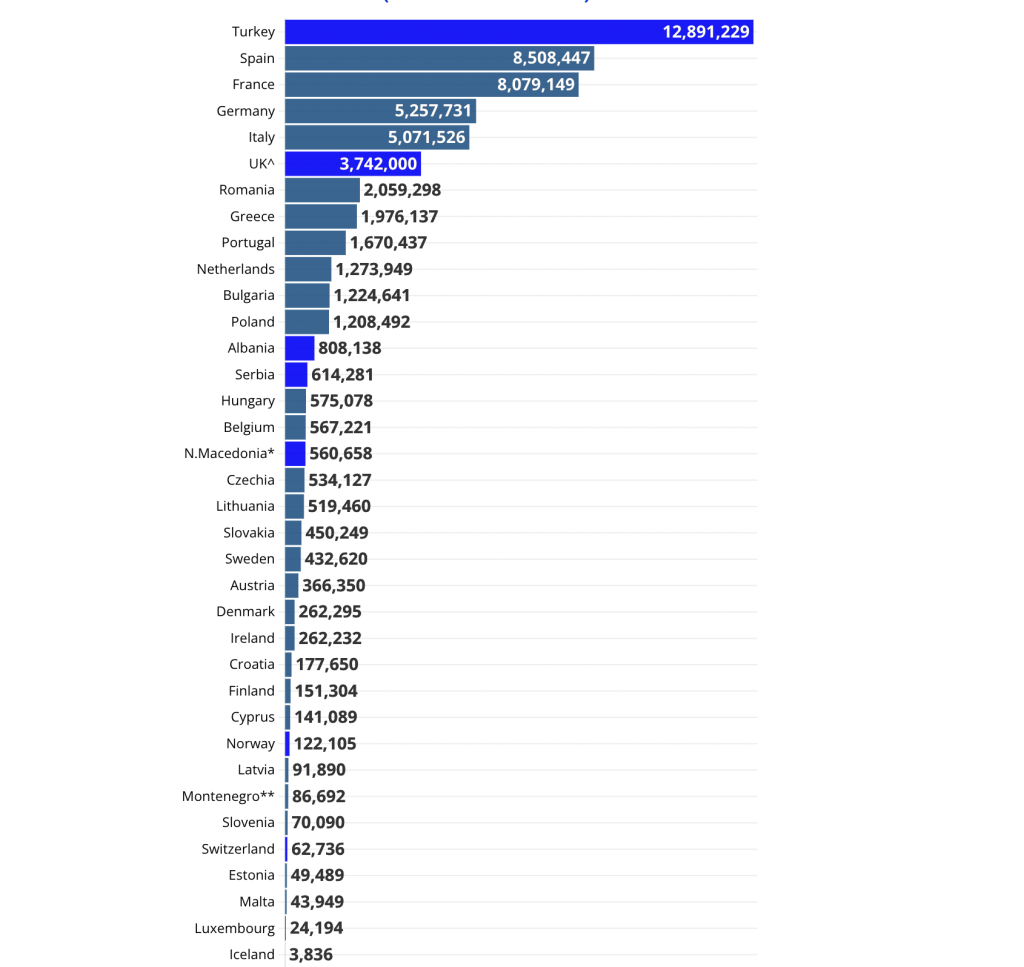
Using 2024 population data, Euronews Business calculated the number of people affected in each country.
- In the EU, the share of people unable to heat their home ranges from 2.7% in Finland to 19% in Bulgaria and Greece.
- Including EU candidate and EFTA countries, the range expands from 0.7% in Switzerland to 33.8% in Albania, with North Macedonia also high at 30.7%.
- Above-average rates are also recorded in Lithuania, Spain, Portugal, Turkey, Cyprus, Montenegro, France, and Romania.
Even in Europe’s largest economies — Germany, Italy, France, and Spain — millions struggle to keep warm.
Although Italy and Germany fall below the EU average, their combined total still exceeds 10 million affected individuals.
Turkey, Spain, and France Lead in Numbers
Among 36 European and neighboring countries, Turkey has the highest number of people living in fuel poverty — approximately 12.9 million in 2024. Paradoxically, Turkey also records some of the lowest energy prices in Europe, both in euro terms and when adjusted for purchasing power standards (PPS).
This contrast highlights a critical issue: low energy prices alone cannot compensate for low household income levels and poor building efficiency, two of the most powerful drivers of energy poverty.
In Spain, about 8.5 million people report being unable to heat their homes adequately, compared with 8.1 million in France, 5.3 million in Germany, and 5.1 million in Italy.
Understanding the Causes of Energy Poverty
According to the European Commission, fuel poverty occurs when households must limit energy consumption to levels that compromise their health and wellbeing. It stems primarily from three interconnected factors:
- Low household income
- High energy costs relative to income
- Poor energy efficiency in homes and appliances
External shocks have worsened the situation.
“The COVID-19 crisis, followed by the surge in energy prices and the Russian invasion of Ukraine in February 2022, worsened an already difficult situation for many EU citizens,”
— European Commission Report on Energy Poverty, 2023
Signs of Recovery — But Challenges Remain
After reaching a historic low in 2019 and 2021, Europe’s energy poverty rates spiked during the energy crisis of 2022–2023. The following year, modest improvements were recorded as gas and electricity prices began to stabilize.
The European Commission attributes this progress to:
- Declining retail energy prices in some member states
- Expanded energy-efficiency renovation programs
- Targeted national subsidies for vulnerable consumers
- Greater public awareness and data collection on energy poverty
However, with ongoing inflation, aging housing stock, and uneven national policies, millions remain vulnerable — particularly in southern and eastern Europe.
A Growing Social and Policy Imperative
The persistence of energy poverty across Europe underscores a fundamental question of equity and sustainability.
Energy efficiency measures, social protection policies, and long-term investment in renewable infrastructure remain essential to ensuring that no European household is left in the cold.
As the EU moves toward its 2030 climate and energy goals, addressing fuel poverty will be critical to achieving a just energy transition — one that protects people as well as the planet.