
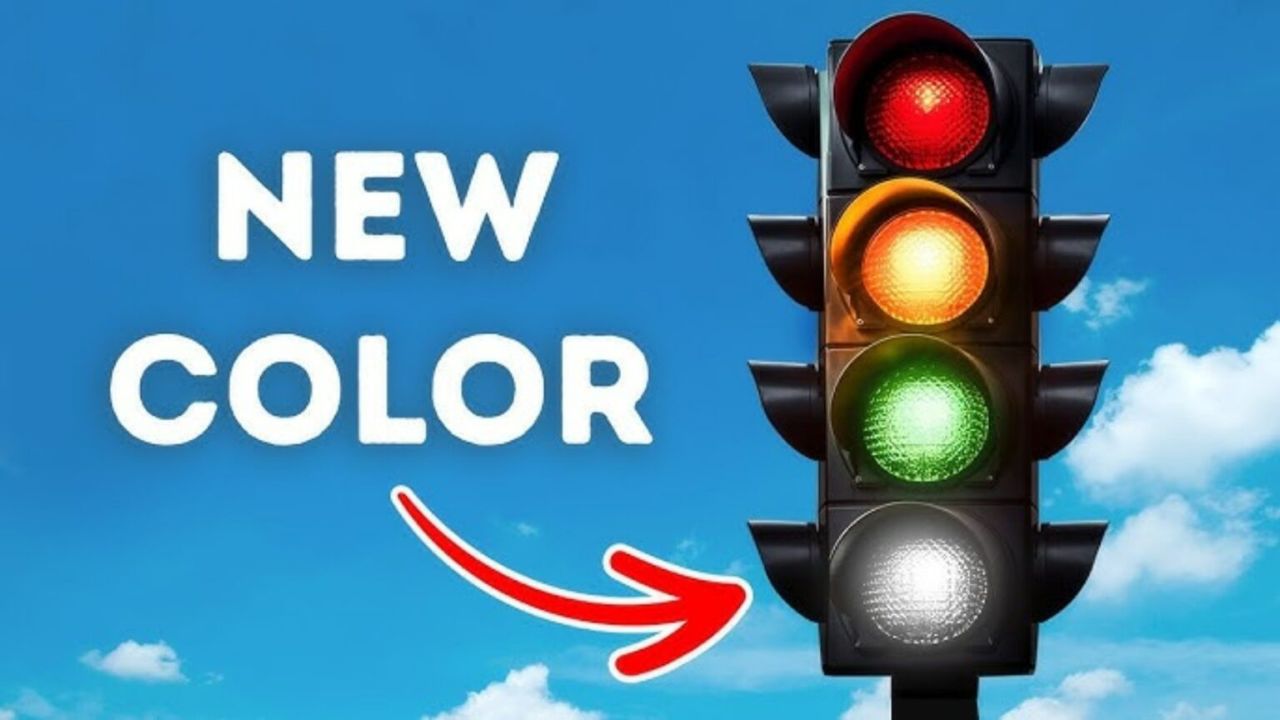
For more than a century, traffic lights have spoken the same simple language: red to stop, yellow to slow, and green to go. But as vehicles become smarter, researchers say our traffic signals might soon do the same.
Goodbye to traditional traffic lights
A team at North Carolina State University (NCSU) has proposed adding a fourth traffic light — white — designed to help human and autonomous cars share intersections more efficiently. The idea, called the “white phase”, could fundamentally change how cities manage traffic in the coming decade.
According to Dr. Ali Hajbabaie, associate professor of civil, construction, and environmental engineering at NCSU, “The white phase isn’t replacing the traditional system. It’s an overlay that helps vehicles communicate with the infrastructure and each other. When enough autonomous cars are nearby, they can coordinate movement better than any human-controlled signal could.”
The U.S. Department of Transportation has expressed interest in supporting pilot programs beginning in 2026, potentially making this one of the first major traffic-signal overhauls since the 1920s.
How the “White Phase” Works?
At its core, the concept is based on vehicle-to-everything (V2X) communication — where cars share real-time information about speed, direction, and intent with each other and with traffic control systems.
Here’s how it functions:
- Autonomous vehicles approach an intersection equipped with V2X technology.
- The traffic light detects that a critical mass of these vehicles is present.
- The signal activates the white light, telling human drivers to follow the lead of nearby autonomous vehicles.
- Once the number of autonomous cars drops, the light returns to normal red-yellow-green operation.
In this system, the white light doesn’t command human drivers directly. Instead, it signals that they should follow the behavior of vehicles ahead — particularly if those are self-driving.
“It’s not about taking control away from humans,” said Dr. Hajbabaie. “It’s about reducing confusion and delay. The more vehicles that can make synchronized decisions, the smoother the flow for everyone.”
Proven to Reduce Congestion and Emissions
Early simulations and controlled tests at NCSU’s Traffic Simulation Laboratory show promising results.
Even when only 10% of vehicles in the system were autonomous, traffic delays dropped by about 3%. As adoption increases, the benefits grow sharply. At 90% autonomy, models predict up to 30% reductions in delay times — a near-elimination of rush-hour gridlock.
That means fewer engines idling and less fuel burned. According to estimates from the U.S. Environmental Protection Agency (EPA), every 10 minutes of reduced idling per vehicle could save up to 1.6 pounds of CO₂ emissions daily in high-traffic areas.
Where the White Light Will Appear First?
Before hitting public streets, the white light will undergo rigorous field testing in controlled environments.
Likely candidates include:
- Ports and logistics hubs, where autonomous trucks already operate.
- Industrial zones with limited pedestrian traffic.
- Private smart-city testbeds, such as the one at North Carolina’s Smart Road Corridor.
The Federal Highway Administration (FHWA) will oversee early trials to ensure that human drivers understand and safely respond to the new signal.
Elaine Thompson, a transportation policy analyst at FHWA, noted, “Introducing a fourth color requires retraining, public education, and regulatory updates. It’s not something that happens overnight — but the potential safety and efficiency benefits are substantial.”
Human Drivers and Trust in Automation
A key part of the challenge lies not in technology, but psychology. Researchers are studying how human drivers interpret and respond to signals that rely on machine behavior.
“Drivers need to trust that autonomous vehicles will make predictable, safe decisions,” said Dr. Sarah Kim, an expert in human–machine interaction at the University of Michigan Transportation Research Institute. “The white light helps by simplifying the driver’s role — you just follow the flow. But that trust must be earned through consistent, transparent performance.”
Potential National Implications
If successful, the white phase could become a national standard, requiring updates to the Manual on Uniform Traffic Control Devices (MUTCD) — the federal guide that dictates how all traffic signals and signs are displayed in the U.S.
That process would take several years and require coordination between state DOTs, automakers, and technology providers. Still, experts believe this change could pave the way for the next century of traffic control.
FAQ: The New “White Light” Traffic Signal
Will this replace red, yellow, and green lights?
No. The white phase is an additional signal that activates only when autonomous vehicles can safely manage the intersection.
What should I do if I see a white light?
Follow the vehicle ahead — especially if it’s autonomous. The system is designed to coordinate movements automatically.
Will all intersections get the new light?
Not at first. It will be introduced only in areas where autonomous vehicle traffic is common and technology is in place.
Is it mandatory for cars to communicate with traffic lights?
Eventually, most new vehicles will include V2X communication systems, but early adoption will be limited to test fleets and newer models.
Will it make driving safer?
Yes — simulations show fewer collisions and smoother traffic flow because decisions are coordinated rather than reactive.
A Glimpse of the Future Road
The introduction of a white traffic light marks more than a technical change — it signals a cultural shift toward shared decision-making between humans and machines.
Just as electric vehicles redefined how we power our cars, this development may redefine how we move through cities. As automation grows, so too must the systems that guide it.
The red, yellow, and green lights of the past kept drivers from chaos. The white light of the future might keep us — and our driverless companions — moving in harmony.