
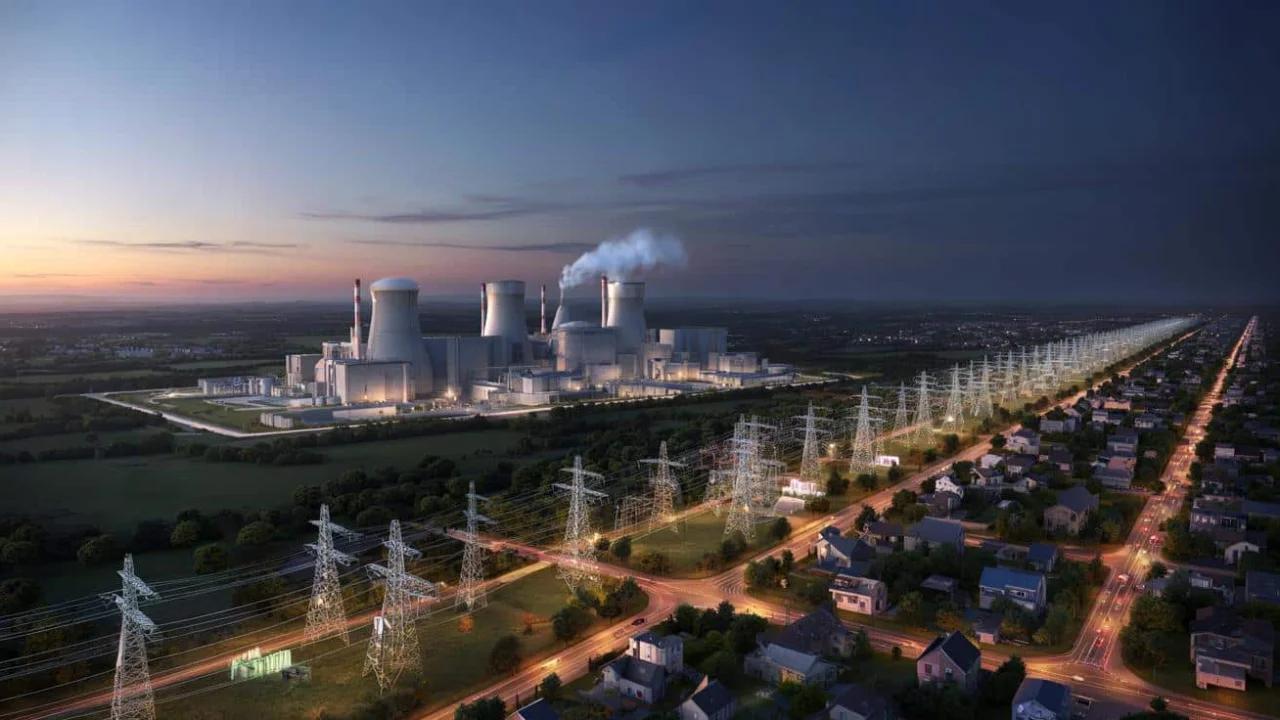
The €72.8 billion price tag for France’s nuclear renaissance may seem astronomical, but it’s dwarfed by an even more expensive challenge lurking in the shadows. While politicians debate reactor designs and environmental activists protest uranium, the real financial earthquake is happening in the unglamorous world of power lines, transformers, and distribution networks. The french electricity grid needs a complete overhaul that will cost nearly three times more than the nuclear reactors themselves.
This infrastructure revolution represents one of the most significant industrial undertakings in French history. Every wire, every substation, every smart meter must be reimagined for a world where electric vehicles charge in driveways, heat pumps warm homes, and solar panels dot rooftops across the countryside. The stakes couldn’t be higher—France’s energy independence and climate goals hang in the balance.
As EDF announces its €72.8 billion nuclear programme, engineers are quietly calculating an even bigger bill. The modernisation of France’s electrical infrastructure will require approximately €200 billion by 2040, making it the largest infrastructure project the country has ever attempted. This silent revolution will touch every French citizen, yet remains largely invisible in public discourse.
The Nuclear Programme’s Real Numbers
EDF has finally put a concrete figure on France’s nuclear comeback: €72.8 billion for six new EPR2 reactors. This estimate, expressed in 2020 euros, represents the “overnight” construction cost—a theoretical calculation assuming all reactors are built simultaneously. The figure excludes financing charges but includes substantial risk provisions that reflect hard-learned lessons from previous nuclear projects.
The three selected sites tell a strategic story. Penly on the Channel coast, Gravelines near Belgium, and Bugey on the Rhône were chosen for their existing nuclear infrastructure and grid connections. Each location already hosts operational reactors, reducing the complexity of integrating new units into the national power system.
EDF’s board has approved an initial €2.7 billion for 2026, but this money won’t build reactors. Instead, it will fund the unglamorous but essential preparatory work: design studies, engineering assessments, long-lead equipment procurement, and industrial preparation. These early investments represent the foundation upon which the entire programme depends.
What People Are Saying
Αρσεναλ – Σάντερλαντ: (X) 0-0 τελικό
— Pathfinder Sports (@pathfinderSport) February 21, 2009
Grid Transformation Dwarfs Nuclear Investment
While €72.8 billion captures headlines, the real financial challenge lies in France’s aging electrical infrastructure. The numbers are staggering:
- High-voltage transmission (RTE): €100 billion investment planned through 2040
- Local distribution (Enedis): €96 billion for network adaptation to new technologies
- Smart grid integration: Billions more for digital monitoring and control systems
- Industrial connections: Major upgrades needed for new factories and data centres
- Renewable integration: Infrastructure to handle variable solar and wind power
The combined network investment approaches €200 billion—nearly three times the cost of six new nuclear reactors. This comparison fundamentally reshapes how we should think about French energy policy. The debate shouldn’t focus solely on “nuclear versus renewables” but rather on “generation versus distribution.”
“The grid is the nervous system of the energy transition,” explains Marie Dubois, senior analyst at the French Energy Institute. “Without massive infrastructure investment, even the most advanced reactors or efficient solar panels become worthless. We’re essentially rebuilding France’s electrical nervous system from scratch.”
Annual Investment Comparison
| Investment Category | Total Cost (€ billions) | Annual Average (€ billions) | Timeline |
|---|---|---|---|
| EPR2 Nuclear Programme | 72.8 | 3.6 | 2025-2045 |
| Transmission Network (RTE) | 100 | 5.9 | 2023-2040 |
| Distribution Network (Enedis) | 96 | 5.6 | 2023-2040 |
| Total Grid Investment | 196 | 11.5 | 2023-2040 |
The Hidden Complexity of Grid Modernisation
Modernising the french electricity grid involves challenges that make nuclear construction look straightforward. Every component must be upgraded simultaneously while maintaining continuous power supply to 67 million French citizens and countless businesses.
The technical challenges are immense. Traditional grids were designed for one-way power flow from large centralized plants to consumers. Tomorrow’s network must handle bidirectional flows as millions of rooftop solar installations feed power back into the system. Electric vehicle charging creates entirely new demand patterns, while industrial electrification adds massive new loads.
“We’re performing open-heart surgery on a patient who must keep running,” says Jean-Paul Martin, former RTE executive. “Every upgrade must be carefully choreographed to avoid blackouts. It’s engineering complexity on a scale France has never attempted.”
Smart meters represent just the visible tip of this transformation. Behind each device lies a web of sensors, communication networks, and control systems that enable real-time grid management. The french electricity grid is evolving from a mechanical system into a digital nervous system capable of responding to changing conditions within milliseconds.
Regional Investment Priorities
Grid investment isn’t uniform across France. Different regions face distinct challenges that require targeted solutions:
- Île-de-France: Urban density requires underground cables and compact substations
- Southern regions: Solar integration demands sophisticated voltage management systems
- Atlantic coast: Offshore wind connections require new submarine cables
- Industrial northeast: Steel and chemical plants need high-capacity connections
- Alpine regions: Hydroelectric integration and seasonal demand variations
- Rural areas: Long-distance connections for dispersed renewable generation
Economic Impact Beyond Construction
The €200 billion grid investment will reshape France’s industrial landscape. Domestic manufacturers are positioning themselves to supply transformers, cables, and control equipment. Foreign companies are establishing French operations to capture market share.
Employment implications are substantial. Grid modernisation is labor-intensive, requiring skilled electricians, engineers, and technicians across the country. Unlike nuclear construction, which concentrates jobs at a few reactor sites, grid work spreads employment opportunities nationwide.
“Grid investment creates jobs in every French department,” notes economist Claire Rousseau. “From cable installation in rural villages to software development in Paris, this programme will employ hundreds of thousands of people for decades.”
The ripple effects extend beyond direct employment. Improved grid reliability and capacity enable new industrial investments that would otherwise be impossible. Data centres, aluminum smelters, and electric vehicle manufacturing all depend on robust electrical infrastructure.
Financing the Infrastructure Revolution
Funding €200 billion in grid improvements presents unique challenges. Unlike nuclear reactors, which generate revenue through electricity sales, grid infrastructure operates as a regulated utility with capped returns. This model limits private investor appetite while requiring steady, long-term financing.
RTE and Enedis rely primarily on regulated tariffs paid by electricity consumers. These charges appear on every French electricity bill, making grid investment costs directly visible to voters. Political pressure to minimize rate increases conflicts with infrastructure investment needs.
European Union funding provides some relief. The Next Generation EU recovery programme and various green transition funds support grid digitalisation and renewable integration projects. However, EU money covers only a fraction of total investment needs.
The french electricity grid investment programme will likely require innovative financing mechanisms. Green bonds, infrastructure funds, and public-private partnerships all feature in current planning discussions. The challenge lies in maintaining investment momentum across multiple electoral cycles and economic conditions.
International Comparison and Lessons
France’s grid investment challenge isn’t unique. Germany has spent over €50 billion on grid expansion since 2010, largely driven by renewable energy integration. The United States faces a $2 trillion infrastructure deficit, including significant electrical grid needs.
China provides an instructive example of large-scale grid modernisation. The country has invested over $300 billion in ultra-high-voltage transmission lines and smart grid technology since 2010. Chinese experience demonstrates both the potential benefits and the coordination challenges of massive infrastructure programmes.
France announces €200B grid modernization alongside €72.8B nuclear programme. The quiet infrastructure revolution that will reshape European energy. #FrenchGrid#EnergyTransition
— Energy Policy Today (@EnergyPolicyEU) January 15, 2024
Future Implications for Energy Security
The success of France’s dual investment in nuclear generation and grid infrastructure will determine the country’s energy future. A modern, resilient french electricity grid enhances energy security by enabling rapid response to supply disruptions and demand fluctuations.
Climate change adds urgency to infrastructure investment. Extreme weather events—heat waves, storms, floods—increasingly stress electrical systems designed for more stable conditions. Grid resilience investment protects against both natural disasters and potential cyber attacks.
The timing is critical. Many existing grid components installed in the 1960s and 1970s are reaching end-of-life status. Deferring replacement risks cascading failures that could paralyze the French economy. The €200 billion investment represents essential maintenance as much as modernisation.
Frequently Asked Questions
Why does grid modernisation cost more than new nuclear reactors?
Grid infrastructure touches every home and business, requiring extensive equipment replacement and system integration across the entire country.
How will French electricity bills change with €200 billion in grid investment?
Bills will likely increase gradually through regulated tariffs, but improved efficiency and reliability may offset some costs.
Can France’s electrical grid handle massive electric vehicle adoption?
Current infrastructure cannot support widespread EV adoption without significant upgrades, hence the massive investment programme.
What happens if grid modernisation is delayed or underfunded?
Delayed investment risks blackouts, renewable energy curtailment, and failure to meet climate goals and industrial electrification needs.
How does France’s grid investment compare internationally?
The €200 billion programme represents one of the world’s largest grid modernisation efforts relative to country size.
Will smart grid technology reduce overall electricity consumption?
Smart grids enable better demand management and reduced waste, potentially lowering consumption despite increased electrification of transport and heating.
The parallel investment in nuclear generation and grid infrastructure represents France’s comprehensive approach to energy transition. While reactors generate clean electricity, only a modern grid can deliver that power efficiently and reliably to end users. The success of this dual strategy will influence energy policy decisions across Europe and beyond, making France a crucial test case for large-scale energy system transformation.