
| Key Detail | Information |
|---|---|
| Company | General Fusion (Vancouver) |
| Milestone | First publicly traded pure fusion power company |
| Merger Partner | Spring Valley Acquisition Corp (US SPAC) |
| Valuation | $1 billion |
| Technology | Magnetized Target Fusion with mechanical pistons |
| Current Project | Lawson Machine 26 (LM26) demonstrator |
Canada just created Wall Street’s first pure-play fusion power investment opportunity, and it’s happening faster than anyone expected. General Fusion’s billion-dollar SPAC merger isn’t just another financial transaction—it’s the moment fusion energy stepped out of university labs and into the harsh spotlight of quarterly earnings calls.
This breakthrough comes as global electricity demand surges 40-50% by 2035, driven by data centers, electric vehicles, and industrial electrification. While solar and wind costs have plummeted, their intermittency creates gaps that batteries can’t economically fill at scale. Enter fusion: the promise of compact, carbon-free power that runs 24/7 without weather dependency.
Revolutionary Piston Technology Breaks Fusion Engineering Barriers
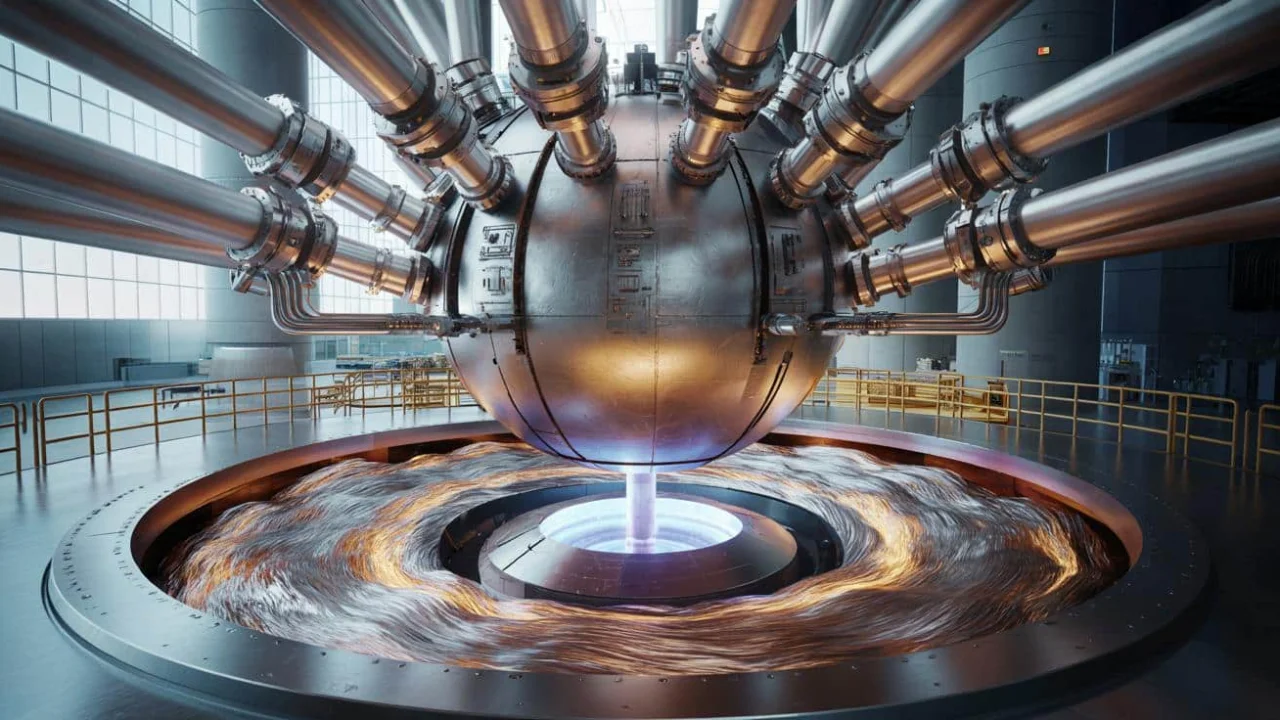
General Fusion’s approach sidesteps the massive magnetic confinement systems that dominate headlines about ITER and other tokamak projects. Instead, their Lawson Machine 26 uses synchronized mechanical pistons to compress plasma inside a sphere of liquid lithium.
The process works like a precisely timed industrial engine: dozens of pistons slam into the metal sphere, sending compression waves toward magnetized plasma at the center. The liquid lithium serves dual purposes—shielding solid components from neutron damage while absorbing fusion energy as heat for electricity generation.
Unlike traditional solid reactor walls that crack and become radioactive under neutron bombardment, the liquid metal surface constantly renews itself. This eliminates one of fusion’s thorniest engineering challenges and could make maintenance as routine as changing engine oil.
“This represents a fundamental shift from treating fusion as a physics experiment to engineering it like industrial equipment,” says a clean energy investment analyst tracking the sector.
Strategic Financing Targets Commercial Deployment Timeline
The SPAC merger provides General Fusion with approximately $320 million in funding—$100 million from oversubscribed private rounds plus $220 million from the acquisition vehicle’s cash reserves. This capital specifically targets completing LM26 operations and advancing toward grid-scale prototypes.
The company has structured its development around three critical milestones:
- Achieving 1 keV temperatures (10 million degrees Celsius) for plasma stability
- Reaching 10 keV (100 million degrees) where fusion reactions become efficient
- Meeting the Lawson criterion for net energy gain
LM26’s chamber already measures half the diameter of a planned commercial reactor, allowing engineers to test real-world issues like component maintenance and thermal management rather than just plasma physics fundamentals.
Market Forces Accelerating Fusion Investment Momentum
| Energy Challenge | Current Solution Limits | Fusion Advantage |
|---|---|---|
| Baseload power demand | Natural gas emits CO₂ | Zero carbon, continuous operation |
| Grid stability | Wind/solar intermittency | Dispatchable on-demand power |
| Energy storage | Battery costs and duration limits | No storage required |
| Industrial heat | Limited clean high-temp options | Steam and electricity cogeneration |
Private investment in fusion power has exploded as institutional investors recognize these market gaps. Helion Energy recently raised $400 million with backing from OpenAI’s Sam Altman, while Commonwealth Fusion Systems has attracted over $2 billion in funding.
Each company pursues different technical approaches—Helion focuses on direct electricity conversion, while General Fusion emphasizes proven thermal turbine systems. However, all share the conviction that fusion will reach commercial viability during the 2030s if capital deployment accelerates now.
Public Markets Create New Fusion Investment Dynamics
General Fusion’s stock market listing fundamentally changes how institutional capital can access fusion opportunities. Previously, pension funds and retail investors could only gain exposure through diversified clean energy funds or venture capital partnerships with lengthy lock-up periods.
A publicly traded pure-play fusion company offers direct, liquid exposure to the technology’s development milestones. Portfolio managers can now allocate specific percentages to fusion alongside solar, wind, and battery positions.
This accessibility comes with trade-offs. Public markets demand quarterly progress updates and react sharply to technical setbacks or timeline delays. Fusion development requires patience for complex engineering challenges that don’t align neatly with earnings calendars.
“Going public accelerates capital access but introduces volatility that private development timelines don’t typically face,” notes a venture capital analyst specializing in energy hardware.
Technical Differentiation Among Global Fusion Approaches
General Fusion’s magnetized target fusion sits between the two dominant approaches—magnetic confinement and inertial fusion. This positioning offers potential advantages in plant economics and engineering complexity.
Magnetic confinement systems like ITER require superconducting magnets and complex plasma control systems. Inertial fusion demands precision lasers and high repetition rates. General Fusion’s mechanical approach relies on hydraulics, pistons, and liquid metal systems—technologies with established industrial supply chains.
The bet underlying their $1 billion valuation assumes that mature mechanical systems will achieve commercial deployment faster and cheaper than exotic physics approaches. Time will test whether this engineering philosophy translates into market advantage.
Canadian Regulatory Framework Supports Fusion Development
Canada’s nuclear regulator has established preliminary frameworks for fusion facility licensing, positioning the country ahead of many jurisdictions still developing fusion governance. This regulatory clarity reduces development risk compared to markets with uncertain approval pathways.
Canadian fusion plants could supply both domestic electricity needs and export clean power to the United States through existing grid interconnections. The country’s existing nuclear expertise and supply chains provide additional deployment advantages.
Beyond electricity generation, fusion plants could supply high-temperature steam for industrial processes, hydrogen production, or synthetic fuel creation—applications that enhance plant economics beyond simple power sales.
“Canada’s combination of regulatory clarity, grid infrastructure, and industrial base creates compelling conditions for commercial fusion deployment,” observes a energy policy researcher.
Investment Implications and Risk Assessment
General Fusion’s public listing creates both opportunities and risks that investors must carefully evaluate. The company’s mechanical approach potentially offers faster deployment than competing technologies, but it also faces unique engineering challenges around piston synchronization and liquid metal handling.
Key technical milestones over the next 24 months include:
- ✓ LM26 plasma temperature achievements above 10 million degrees
- ✓ Demonstration of net energy gain conditions
- ✓ Long-duration operation proving system reliability
- ✓ Components testing for commercial-scale systems
Market reception will depend heavily on these technical results, competitive developments, and broader clean energy investment trends. SPAC investments historically show high volatility, particularly in emerging technology sectors.
However, the $320 million funding provides substantial runway for development work, reducing near-term financial risk compared to earlier-stage fusion ventures relying on incremental private funding rounds.
What happens if General Fusion succeeds in demonstrating net energy gain?
Success would likely accelerate commercial plant development and attract additional capital for grid-scale deployment.
How does mechanical fusion compare to magnetic confinement approaches?
Mechanical systems use proven industrial technologies but require precise synchronization at extreme temperatures.
Why choose a SPAC merger over traditional IPO?
SPACs offer faster market access and negotiation flexibility for complex technology companies.
What regulatory approvals does commercial fusion require?
Fusion plants need nuclear facility licenses but face less stringent requirements than fission reactors.
When could General Fusion plants begin commercial operation?
The company targets grid-connected demonstration plants during the 2030s if development proceeds on schedule.
How does liquid lithium wall technology work?
Circulating liquid metal absorbs neutrons and heat while continuously renewing the plasma-facing surface.
Transforming Energy Markets Through Financial Innovation
General Fusion’s public market debut represents more than a single company’s financing milestone. It signals fusion power transition from research curiosity to investable infrastructure, creating pathways for pension funds, sovereign wealth funds, and retail investors to participate in the technology’s commercial development.
The success or failure of this pioneering public fusion company will influence how capital markets approach the entire sector. Strong performance could trigger a wave of fusion IPOs and SPAC mergers, while significant setbacks might push the industry back toward private funding models.
Either outcome accelerates fusion’s evolution from laboratory science toward industrial reality. By subjecting fusion development to public market discipline, Canada has essentially created a real-world test of whether the technology can meet the commercial timelines and performance metrics that investors demand—ultimately determining whether fusion energy becomes a mainstream solution to global climate and energy challenges.