
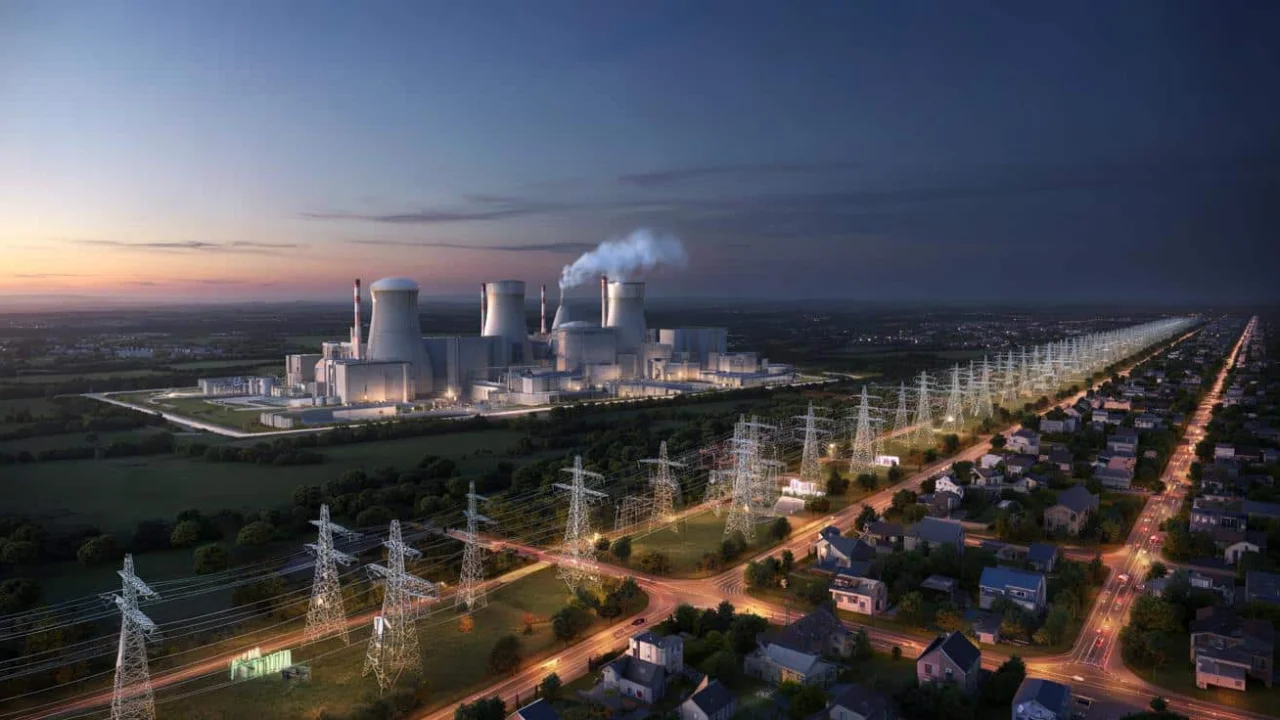
The electricity revolution sweeping across France tells a story far bigger than its headline-grabbing nuclear reactors. While President Macron champions a new generation of EPR2 reactors with a €72.8 billion price tag, the real transformation lies hidden in plain sight – threading through power lines, substations, and smart meters across the hexagon. This quiet revolution will cost nearly three times more than the reactors themselves.
For decades, France built its energy identity around nuclear power, creating one of the world’s cleanest electricity systems. Now, as the country prepares for its nuclear renaissance, engineers and financiers are discovering that the most expensive challenge isn’t splitting atoms – it’s moving the electricity those atoms create. The numbers reveal a startling truth that reshapes how we think about France’s energy future.
The contrast couldn’t be starker. While politicians debate the merits of france nuclear reactors versus renewable energy, the real money flows into an unsexy but essential transformation of the national grid. This infrastructure overhaul represents one of Europe’s largest industrial undertakings, yet it receives a fraction of the public attention devoted to nuclear debates.
The Nuclear Price Tag Revealed
EDF, France’s state-controlled utility giant, has finally put numbers to its nuclear ambitions. The construction cost for six new EPR2 reactors now stands at €72.8 billion, expressed in 2020 euros. These units will rise at three existing nuclear sites: Penly on the Channel coast, Gravelines near the Belgian border, and Bugey on the Rhône River.
This figure represents “overnight” construction costs – as if all reactors were built simultaneously, excluding financing charges but including substantial risk provisions. EDF’s board has already approved an initial €2.7 billion for 2026, funding design work, engineering studies, and long-lead equipment orders rather than concrete and steel.
The risk provisions deserve particular attention. EDF openly acknowledges they are deliberately high, reflecting hard-learned lessons from delays plaguing other nuclear projects worldwide. This more realistic, less optimistic approach marks a departure from earlier cost estimates that consistently proved too low.
“The nuclear industry has learned painful lessons about cost overruns and delays. These risk provisions represent a more mature approach to major infrastructure projects,” explains Dr. Marie Dubois, energy economist at the Sorbonne.
Grid Modernisation: The Hidden Giant
While €72.8 billion commands attention, it pales beside the infrastructure transformation happening across France. The national transmission operator RTE plans approximately €100 billion of investment by 2040. Distribution company Enedis anticipates roughly €96 billion to adapt local networks for electric vehicles, heat pumps, decentralised solar, and new industrial sites.
Combined, these network upgrades approach €200 billion – almost three times the cost of new france nuclear reactors. This massive investment reflects fundamental changes in how electricity flows through modern societies.
The traditional model assumed large power plants feeding electricity through high-voltage lines to passive consumers. Today’s reality involves millions of solar panels, electric car chargers, heat pumps, and batteries creating bidirectional energy flows that challenge century-old infrastructure assumptions.
| Investment Category | Estimated Cost (€ billions) | Timeline | Primary Purpose |
|---|---|---|---|
| EPR2 Nuclear Reactors | 72.8 | 2026-2045 | Electricity Generation |
| RTE Transmission Grid | 100 | 2024-2040 | High-voltage Networks |
| Enedis Distribution Grid | 96 | 2024-2040 | Local Networks & Smart Systems |
| Total Grid Investment | 196 | 2024-2040 | Complete Network Modernisation |
Why Networks Cost More Than Nuclear
Several factors drive the massive grid investment requirements:
- Electrification wave: Electric vehicles, heat pumps, and industrial processes create unprecedented demand for electricity infrastructure
- Decentralised generation: Rooftop solar, wind farms, and battery storage require sophisticated grid management systems
- Smart grid technology: Modern networks need sensors, communications, and automated control systems
- Resilience requirements: Climate change and cybersecurity threats demand more robust infrastructure
- Geographic spread: Unlike centralised nuclear plants, grid improvements must reach every corner of France
The transformation extends beyond mere cables and towers. Smart meters, advanced sensors, automated switching systems, and cybersecurity measures create a digital nervous system for France’s electricity supply. This technological evolution requires coordination across thousands of components and millions of connection points.
“We’re essentially rebuilding the entire electricity system while keeping the lights on. It’s like performing heart surgery on a marathon runner,” notes Jean-Baptiste Rousseau, grid modernisation expert at École Polytechnique.
Annual Spending in Context
The six-reactor EPR2 programme stretches across roughly two decades, creating an annual average spending of approximately €3.6 billion per year. Energy economists compare this to France’s fossil fuel import bill, which fluctuated between €50 billion and €110 billion annually in recent years, depending on oil and gas prices.
This comparison illuminates the economic logic behind france nuclear reactors. Even with substantial upfront costs, domestic nuclear generation reduces dependence on volatile international energy markets. The Ukraine conflict and subsequent energy price spikes reinforced this strategic calculus.
Grid investments follow a different timeline, with peak spending concentrated in the next decade as France races to accommodate electric vehicle adoption and renewable energy integration. This front-loaded investment pattern creates significant near-term budget pressures for utilities and ultimately consumers.
Industrial and Strategic Implications
The massive infrastructure spending creates opportunities and challenges across France’s industrial landscape:
- Cable manufacturers: Unprecedented demand for high-voltage and distribution cables
- Digital technology firms: Smart grid sensors, software, and cybersecurity solutions
- Construction companies: Thousands of kilometres of new power lines and upgraded substations
- Engineering services: Complex system integration and project management expertise
- Steel and concrete producers: Raw materials for transmission towers and infrastructure foundations
Unlike nuclear reactor construction, which concentrates activity at specific sites, grid modernisation spreads economic benefits across France’s entire territory. Rural areas installing new transmission lines and urban districts upgrading distribution networks both participate in the infrastructure boom.
International suppliers also compete for contracts, particularly in advanced digital grid technologies where European companies face competition from American and Asian firms. This dynamic creates both opportunities for French industry and concerns about technological sovereignty.
Environmental and Social Considerations
The €200 billion grid investment raises environmental questions often overlooked in nuclear debates. New transmission lines cross protected landscapes, underground cables disturb urban areas, and smart meters raise privacy concerns among some citizens.
Environmental impact assessments for grid projects often prove more complex than those for nuclear plants. While reactors concentrate environmental effects at specific sites, transmission networks create dispersed impacts across thousands of kilometres. This geographical spread complicates environmental planning and public consultation processes.
Social acceptance varies significantly. Many French citizens support france nuclear reactors in principle but oppose specific transmission lines near their communities. This “not in my backyard” phenomenon creates practical challenges for grid operators seeking optimal routing for new infrastructure.
“The energy transition requires social consensus not just about generation technologies but about the infrastructure that connects them. This is often the harder conversation,” observes Dr. Catherine Lambert, energy policy researcher at Sciences Po.
The smart meter deployment illustrates these tensions. While technically necessary for grid modernisation, some citizens worry about privacy, electromagnetic radiation, and corporate surveillance. These concerns, whether scientifically justified or not, create political headaches for policymakers promoting grid upgrades.
European Context and Competition
France’s dual investment in nuclear generation and grid infrastructure occurs within a broader European energy transformation. Neighbouring countries pursue different strategies, creating competitive dynamics and cooperation opportunities.
Germany’s renewable energy transition requires massive grid investments to connect northern wind farms with southern industrial centres. The UK combines nuclear new-build with offshore wind expansion. These parallel transformations create opportunities for cross-border electricity trade but also infrastructure coordination challenges.
European Union climate policies drive much of the grid investment through renewable energy mandates and electrification targets. However, EU funding covers only a small fraction of national grid modernisation costs, leaving member states to finance most improvements independently.
Technology Risks and Opportunities
The €196 billion grid investment bet heavily on emerging technologies whose long-term reliability and cost-effectiveness remain uncertain. Smart grid systems, advanced sensors, and automated control systems represent technological frontiers rather than proven solutions.
Cybersecurity presents particular challenges. Modern electricity grids increasingly rely on digital communications and internet-connected devices, creating potential vulnerabilities to cyberattacks. Protecting critical infrastructure while maintaining operational efficiency requires sophisticated and expensive security measures.
Conversely, technological advances could reduce costs and improve performance beyond current expectations. Artificial intelligence applications in grid management, advanced materials for power cables, and improved energy storage systems might deliver better results than conservative projections suggest.
Frequently Asked Questions
Why does grid modernisation cost more than new nuclear reactors?
Grid upgrades must reach every corner of France, while nuclear plants concentrate at specific sites.
When will French consumers see these infrastructure costs in their electricity bills?
Grid investment costs typically appear in electricity bills over 15-20 year amortisation periods.
Can France finance both nuclear reactors and grid modernisation simultaneously?
Yes, through combination of state support, utility borrowing, and regulated cost recovery mechanisms.
How do French grid costs compare with other European countries?
Similar per-capita investments across Europe, though France’s nuclear focus creates different technology requirements.
What happens if grid modernisation falls behind nuclear reactor construction schedules?
New reactors could face connection delays, reducing their economic value and system benefits.
Will smart grid technology reduce long-term electricity costs for French consumers?
Potentially yes, through improved efficiency and reduced system operating costs over time.