
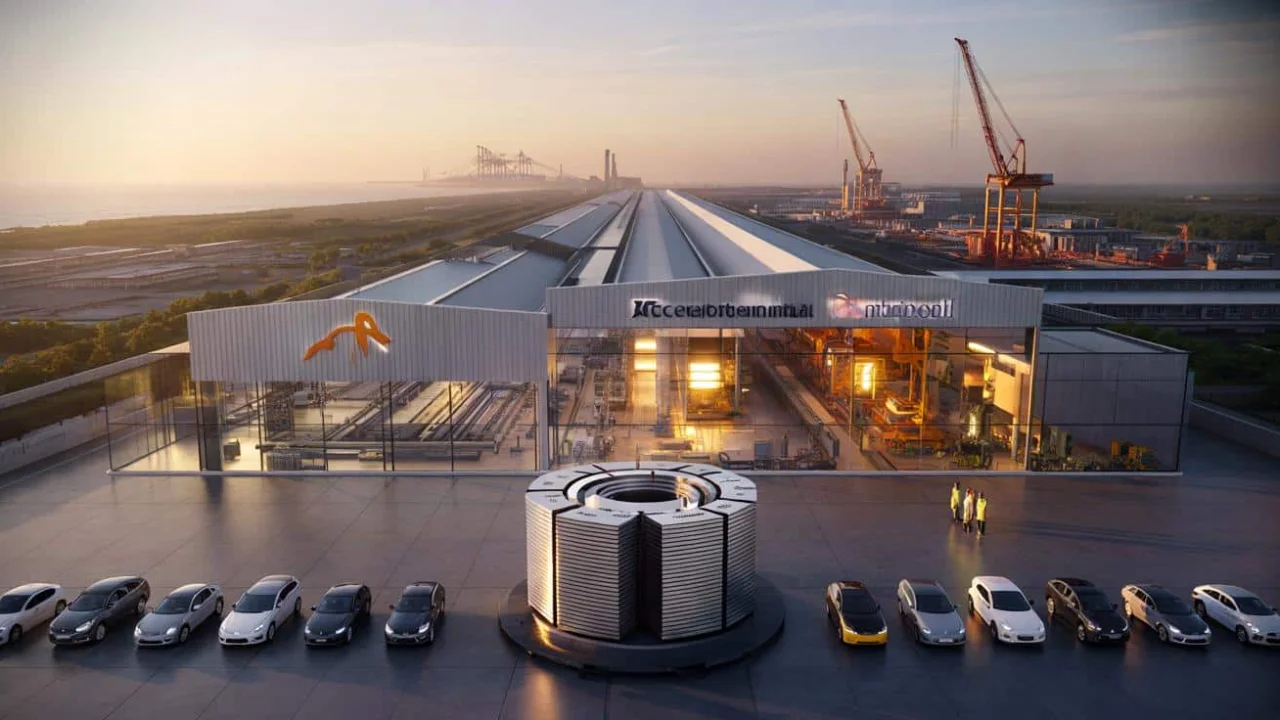
Marie-Claire Dubois has worked at ArcelorMittal’s Dunkirk facility for twelve years, but she’s never seen anything quite like this. Standing beside the massive new production lines at nearby Mardyck, she watches thin strips of specially treated steel emerge from precision rollers – metal so fine it could revolutionize how electric motors work across Europe. “This isn’t the steel industry I grew up around,” she says, holding up a sample barely thicker than paper. “This is the future.”
Her story reflects a broader transformation sweeping through northern France, where a €500 million investment is positioning the region at the heart of Europe’s electric transition. The electric steel market, valued at €32 billion in 2023, represents more than just another industrial pivot – it’s becoming the magnetic backbone of everything from electric vehicles to smart power grids.
“Without high-grade electric steel, we simply cannot build the efficient motors and transformers that make electrification economically viable,” says a materials engineering consultant familiar with the project.
How ArcelorMittal’s Massive Bet Could Reshape European Manufacturing
At Mardyck, just kilometers from Dunkirk’s industrial coastline, ArcelorMittal is constructing one of Europe’s most ambitious electric steel facilities. Three production lines will operate by late 2025, expanding to five by 2027. The goal extends far beyond traditional steelmaking – this facility aims to capture a significant portion of a global market projected to reach €57 billion by 2032.
The investment represents both technological advancement and strategic repositioning. While Chinese competitors dominate global steel markets through volume and price, ArcelorMittal is betting on precision, proximity, and performance. Electric steel requires entirely different capabilities than conventional structural steel, demanding molecular-level control over magnetic properties rather than raw strength.
| Production Phase | Timeline | Annual Capacity | Investment Value |
|---|---|---|---|
| Phase 1 (3 lines) | End 2025 | 95,000 tonnes | €300 million |
| Phase 2 (5 lines) | 2027 | 155,000 tonnes | €500 million total |
| Combined French capacity | Full operation | 295,000 tonnes | With Saint-Chély site |
Who Benefits Most From This Electric Steel Revolution
The ripple effects of Mardyck’s production will touch multiple sectors across Europe:
- If you manufacture electric vehicles, then locally sourced electric steel reduces supply chain risks and improves motor efficiency by 2-3%
- If you operate wind farms, then advanced transformer cores minimize energy losses during power conversion
- If you manage industrial facilities, then high-efficiency motors cut electricity consumption and peak demand charges
- If you work in grid infrastructure, then smart transformers enable better integration of renewable energy sources
- If you’re developing charging networks, then improved motor efficiency reduces the power requirements for each station
What Makes Electric Steel Different From Traditional Production
Electric steel bears little resemblance to the heavy structural beams most people associate with steelmaking. Instead, Mardyck produces ultra-thin strips measuring just 0.2 to 0.35 millimeters thick – roughly the thickness of three sheets of paper.
The manufacturing process involves three critical stages:
- Continuous annealing modifies the crystal structure to optimize magnetic response
- Specialized coatings provide electrical insulation between layers
- Precision slitting cuts wide strips into exact widths specified by motor manufacturers
These seemingly minor details create substantial real-world impacts. Thinner steel generates fewer magnetic losses, which translates directly into longer battery range for electric vehicles and lower electricity bills for industrial users. Across millions of motors and transformers, incremental efficiency gains compound into gigawatts of reduced power demand.
“The electric steel market growth isn’t just about electric cars – it’s driven by the complete modernization of how we generate, distribute, and consume electricity,” explains a power systems analyst.
Why Northern France Became Europe’s Electric Steel Hub
ArcelorMittal’s decision to concentrate European electric steel production in France reflects careful strategic calculation. The Hauts-de-France region has attracted multiple battery gigafactories and automotive suppliers in recent years, creating an integrated ecosystem around Dunkirk and Valenciennes.
Location advantages extend beyond proximity to customers. European automakers face increasing pressure to comply with EU content requirements and carbon footprint reporting standards. Domestically produced electric steel offers both commercial and regulatory benefits, reducing dependence on Asian imports while meeting environmental criteria.
| Market Projection | 2023 Value | 2032 Forecast | Growth Rate |
|---|---|---|---|
| Global electric steel market | €32 billion | €57 billion | 78% increase |
| Mardyck annual output value | N/A | €153-204 million | At full capacity |
| Employment impact | 175 current jobs | 200 projected | Plus construction |
The Hidden Infrastructure Driving Market Growth
While electric vehicles capture headlines, the largest growth driver for electric steel comes from modernizing power networks. As solar panels and wind farms connect to aging grids, operators need transformers and switching equipment capable of handling variable energy flows with minimal losses.
Smart grids require dense networks of sensors, advanced transformers, and compact substations – all containing electric steel cores. Each percentage point of efficiency improvement matters exponentially as electricity demand grows. Data centers, industrial automation, and renewable energy integration all depend on these magnetic materials.
The French state recognized this strategic importance by providing €25 million in support through the “France 2030” programme. This funding targets industrial capabilities deemed critical for low-carbon transition and energy security. Electric steel underpins infrastructure from charging networks to rail systems, making it essential for achieving political climate targets.
Frequently Asked Questions
What exactly is electric steel and why does it matter?
Electric steel is ultra-thin, magnetically optimized metal strips used in motors and transformers to minimize energy losses.
How much electric steel does one electric car need?
A typical electric vehicle uses 20-40 kilograms of electric steel across its motor and charging systems.
Why can’t regular steel work in electric motors?
Regular steel generates excessive heat and energy losses when exposed to changing magnetic fields in motors.
Will this make electric cars cheaper?
Better electric steel improves motor efficiency rather than reducing costs, extending battery range instead.
How does this compete with Chinese steel producers?
European production offers shorter supply chains, environmental compliance, and integration with regional industrial clusters.
“The success of this investment will ultimately depend on how quickly European demand scales and whether customers value local sourcing over pure cost competition,” notes a steel industry financial advisor.
What This Means for Europe’s Industrial Future
The Mardyck facility represents more than manufacturing capacity – it’s a test of whether Europe can maintain technological leadership in critical materials. With 400 people involved during peak construction and over 12,000 hours of specialized training delivered, the project combines hardware investment with skills development.
The facility’s success will influence broader questions about European industrial policy. Can high-tech manufacturing compete globally while meeting strict environmental standards? Will proximity to customers offset higher production costs? The answers will shape how Europe approaches other strategic materials in the coming decade.
For now, northern France gains a combination rarely achieved: large-scale industrial investment, jobs rooted in advanced manufacturing, and a foothold in materials that will define the electrical age. Whether this model can withstand global price pressure remains to be seen, but the electric steel market growth trajectory suggests the timing may be right for such ambitious bets.
Three key takeaways emerge from ArcelorMittal’s massive investment:
- The electric steel market represents a €57 billion opportunity by 2032, driven by electric vehicles and smart grid modernization
- Local production offers strategic advantages through shorter supply chains, environmental compliance, and integration with European manufacturing clusters
- Success depends on scaling European demand quickly enough to justify premium costs compared to Asian competitors