
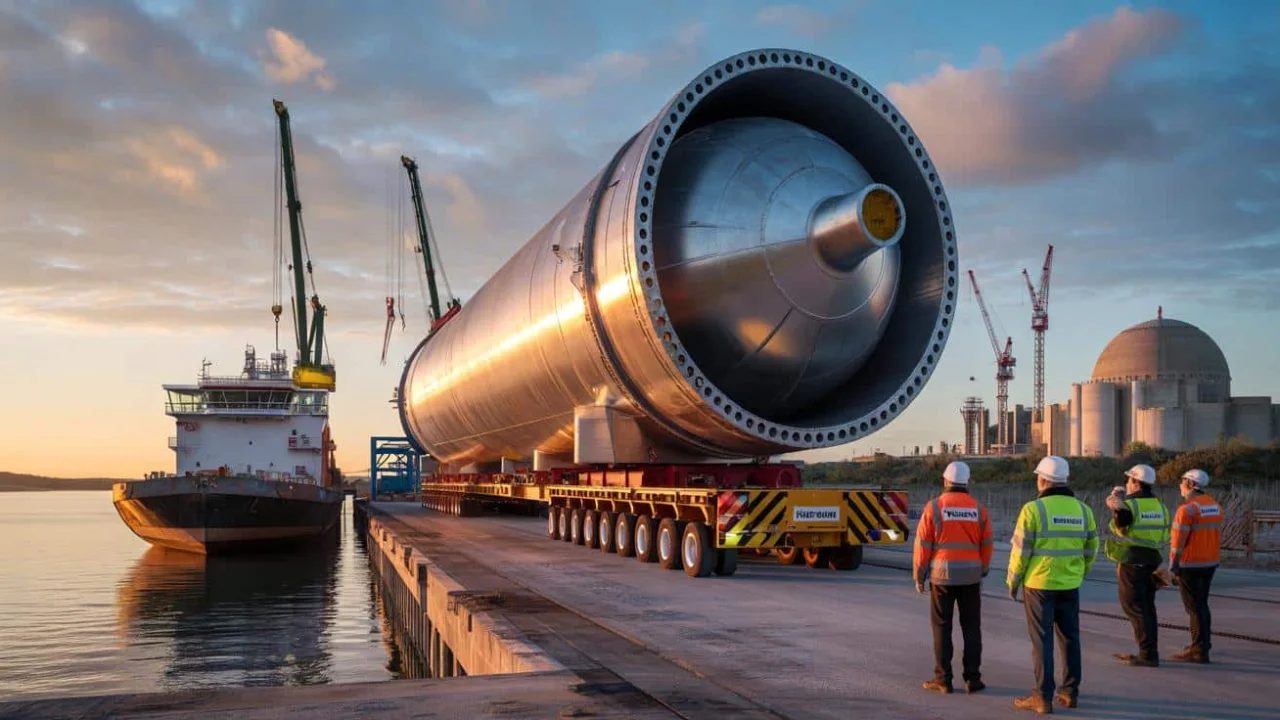
Are you tired of watching your energy bills soar while politicians promise cleaner power that never seems to arrive? Wondering if Britain’s ambitious net-zero plans will actually deliver reliable electricity for your home? The answer may be crossing the English Channel right now in the form of a 500-tonne steel giant.
On November 28, 2025, French nuclear specialist Framatome completed fabrication of the reactor pressure vessel for Unit 2 of Hinkley Point C, marking a pivotal moment in Britain’s energy transformation. This massive steel cylinder, weighing as much as a fully loaded Airbus A380, will soon become the beating heart of the UK’s first new nuclear power station in over three decades.
| Project Detail | Specification |
|---|---|
| Reactor Vessel Weight | 500 tonnes |
| Length | 13 metres |
| Manufacturing Location | Saint-Marcel, France |
| Homes Powered | 6 million households |
| Expected Service Date | 2031 (Unit 2) |
Critical Infrastructure Components Now En Route to Somerset
The completion of this reactor pressure vessel represents far more than a manufacturing milestone. Engineers describe this steel fortress as designed to withstand temperatures of 300°C, pressures exceeding 150 bar, and decades of intense radiation exposure. The vessel’s construction required specialized metallurgy techniques, including precision welding procedures that take months to complete under strict quality control protocols.
The fabrication process at Framatome’s Saint-Marcel facility involved forging the vessel from a single 600-tonne steel ingot, then machining it to exacting tolerances. Advanced ultrasonic testing verified the integrity of every weld seam, while X-ray inspections confirmed the absence of microscopic defects that could compromise safety during decades of operation.
Several key groups will feel the immediate impact of this development:
- Energy industry professionals tracking Britain’s nuclear renaissance and its implications for grid stability
- Somerset residents witnessing the massive construction project firsthand and experiencing local economic benefits
- Policy makers betting on nuclear power for long-term energy security and carbon reduction targets
- Environmental advocates supporting low-carbon baseload electricity to complement renewable sources
- French nuclear engineers demonstrating export capabilities post-Brexit and strengthening bilateral cooperation
- Pension funds and institutional investors monitoring the project’s financial viability and long-term returns
- Nuclear supply chain companies across Europe benefiting from renewed industry confidence
Massive Engineering Feat Signals Britain’s Energy Direction
The reactor vessel’s journey from France to Somerset symbolizes a fundamental shift in UK energy strategy. This 13-meter steel cylinder will house uranium fuel assemblies where nuclear fission generates electricity regardless of weather conditions, providing the steady baseload power that wind and solar cannot deliver during calm, cloudy periods.
The vessel’s design represents decades of nuclear engineering evolution. Its double-wall construction includes an inner pressure boundary made from low-alloy steel and an outer containment structure designed to prevent radioactive releases even under extreme accident scenarios. Sophisticated control rod mechanisms built into the vessel head allow operators to instantly shut down the reactor if needed.
Key changes this milestone brings to Britain’s energy landscape include:
- Demonstration that complex nuclear projects can progress despite political uncertainty and changing governments
- Proof that Franco-British industrial cooperation continues post-Brexit, showing engineering transcends politics
- Evidence of renewed commitment to large-scale nuclear baseload power as renewable intermittency challenges grow
- Progress toward reducing dependence on volatile gas imports and exposure to geopolitical supply disruptions
- Creation of specialized nuclear engineering jobs across both countries, rebuilding lost industrial capabilities
- Validation of the EPR reactor design following successful operations in China and Finland
- Increased confidence among nuclear investors for future UK projects including Sizewell C
The vessel represents the second of two massive components for Hinkley Point C. Unit 1’s reactor vessel, forged at Le Creusot in France, arrived in early 2023 and was installed in late 2024. The precision installation required one of Europe’s most powerful cranes and took several days to complete, with alignment tolerances measured in millimeters.
| Project Metric | Current Status |
|---|---|
| Total Project Cost | £31-34 billion (2015 prices) |
| UK Electricity Share | 7% of national demand |
| Unit 1 Target Date | 2030 |
| Unit 2 Target Date | 2031 |
| Expected Lifetime | 60-80 years operation |
| CO2 Emissions | Near zero during operation |
| Construction Jobs | 25,000 peak workforce |
“The completion of this reactor vessel demonstrates that Britain’s nuclear program can deliver on its promises, even as costs have risen significantly. This represents a crucial test of whether Western democracies can still execute large-scale infrastructure projects in an era of political volatility,” says Dr. Sarah Mitchell, nuclear policy analyst at the Royal Institute of International Affairs.
Economic Reality Behind Britain’s Nuclear Gamble
The financial stakes surrounding this steel vessel are staggering. Latest estimates place the entire project between £31 billion and £34 billion in 2015 money, several billion higher than originally advertised. When adjusted for inflation, current costs approach £45 billion, making this one of Europe’s most expensive construction projects.
However, supporters argue these upfront costs translate into predictable, low-carbon electricity over the reactors’ expected 60-plus year lifespan. Unlike wind and solar power, nuclear plants generate consistent output regardless of weather conditions, providing crucial grid stability as Britain phases out gas-fired power stations.
The economic case becomes more compelling when considering avoided costs. Each year of operation will prevent importing millions of tonnes of liquefied natural gas, reducing exposure to volatile commodity prices that have plagued European energy markets since 2021. The plant will also avoid purchasing carbon credits worth potentially billions over its lifetime as emission trading schemes tighten.
The pressure vessel will be transported by specialized barge through French waterways, then loaded onto heavy-lift convoys for the final journey to Somerset. This logistical operation requires coordination between multiple transport authorities and will temporarily close several roads to accommodate the oversized cargo. Insurance costs alone for this single component exceed £100 million.
Installation presents another challenge. Technicians will use one of Europe’s most powerful cranes to position the vessel through a temporary dome opening in the reactor building. Alignment tolerances are measured in millimeters – any damage during transport or installation could derail the entire project schedule and add hundreds of millions in repair costs.
“When you spread these costs across six decades of operation, nuclear power provides insurance against volatile gas prices and weather-dependent renewables. The question isn’t whether nuclear is expensive upfront, but whether Britain can afford not to have reliable baseload power in a net-zero economy,” explains James Harrison, energy economics consultant at Oxford Energy Associates.
Global Nuclear Renaissance Takes Shape
Hinkley Point C sits within a broader international EPR reactor program showing mixed but increasingly tangible results. While early projects faced significant delays and cost overruns, several units now operate at full commercial power, providing lessons for the British project.
China’s Taishan reactors have operated successfully since 2018-2019, generating over 24 TWh annually with capacity factors exceeding 90%. Finland’s Olkiluoto 3 began commercial operation in 2023 after lengthy delays but now provides 14% of Finnish electricity demand. France’s Flamanville 3 is completing final commissioning tests after overcoming technical challenges that delayed its startup by over a decade.
These operational examples demonstrate both the potential and pitfalls of advanced nuclear technology. While construction proved far more complex than anticipated, the completed reactors deliver exactly the reliable, low-carbon electricity that climate policies demand. Their success has renewed confidence in nuclear power across Europe, with several countries reconsidering phase-out plans.
The EPR design’s enhanced safety features include core catcher systems that contain molten fuel during severe accidents, four independent safety trains that provide redundant cooling, and reinforced containment structures designed to withstand aircraft impacts. These improvements address public concerns stemming from historical accidents while maintaining the economic advantages of large-scale nuclear generation.
“The reactor vessels crossing European borders represent more than industrial cooperation – they’re physical proof that the West can still build complex, long-term infrastructure despite short political cycles and public skepticism. This sets precedents for other climate technologies requiring massive upfront investment,” observes Prof. Michael Thompson, infrastructure investment advisor at Cambridge University.
Technical Challenges and Safety Innovations
The reactor pressure vessel incorporates numerous safety innovations developed since earlier nuclear designs. Its forged steel construction eliminates welded seams in critical areas, reducing potential failure points. Advanced materials resist radiation-induced embrittlement, extending operational life beyond traditional reactor designs.
Internal components include sophisticated monitoring systems that continuously assess vessel integrity. Hundreds of sensors track temperature, pressure, vibration, and radiation levels, providing early warning of any anomalies. Digital control systems can automatically adjust reactor power or initiate emergency shutdown procedures within milliseconds if safety parameters are exceeded.
The vessel’s design also facilitates maintenance and inspection procedures. Removable internals allow comprehensive examinations during scheduled outages, while robotic systems can perform repairs in high-radiation environments without exposing workers to dangerous conditions.
What happens when the reactor vessel fails inspection during transport?
Any structural defect would require complete replacement, potentially delaying the project by 2-3 years and adding billions in costs.
How does this affect British energy bills in the short term?
No immediate impact, but long-term electricity prices depend on future gas costs and carbon pricing policies.
Why import from France instead of building domestically?
Britain lacks the specialized heavy forging facilities required for reactor pressure vessels after decades of nuclear industry decline.
What safety systems protect against severe accidents like Chernobyl?
EPR design includes double containment walls, core catcher systems, and four independent safety cooling circuits.
How long before Unit 2 generates electricity for homes?
Following installation, extensive testing and regulatory approval processes target commercial operation in 2031.
Could delays affect Britain’s net-zero commitments by 2050?
Yes, nuclear delays would require faster renewable deployment and longer reliance on gas-fired backup power.
Your Next Steps as Britain’s Energy Future Unfolds
The arrival of this 500-tonne reactor vessel signals that Britain’s nuclear renaissance is moving from political promise to physical reality. Whether you support or oppose nuclear power, this development will shape your electricity supply for decades to come, influencing everything from household bills to industrial competitiveness.
Stay informed about project progress and cost developments as they directly impact long-term energy policy and public spending commitments. Monitor how Hinkley Point C performs compared to renewable alternatives, particularly during periods when wind and solar output falls short of demand.
Consider how this massive infrastructure investment affects your region’s economic prospects. The project has already created thousands of construction jobs and will require hundreds of permanent positions for plant operation and maintenance. Local supply chains benefit from specialized contracts worth billions over the construction period.
Most importantly, recognize that decisions made today about nuclear power, renewable energy, and grid reliability will determine whether Britain achieves its net-zero commitments while maintaining affordable, secure electricity supply for millions of homes. The reactor vessel’s journey from France represents just one piece of this complex energy transition puzzle.
As this steel giant prepares for its final voyage to Somerset, it carries with it Britain’s hopes for energy independence, climate leadership, and industrial renewal. The success or failure of this ambitious project will influence energy policy decisions for generations, making every citizen a stakeholder in its outcome.