
“What we’ve witnessed over the North Atlantic represents a fundamental shift in how commercial aviation approaches fuel efficiency,” says an aviation systems analyst. “For the first time, we’ve proven that aircraft can safely rendezvous at precise coordinates without compromising existing safety protocols.”
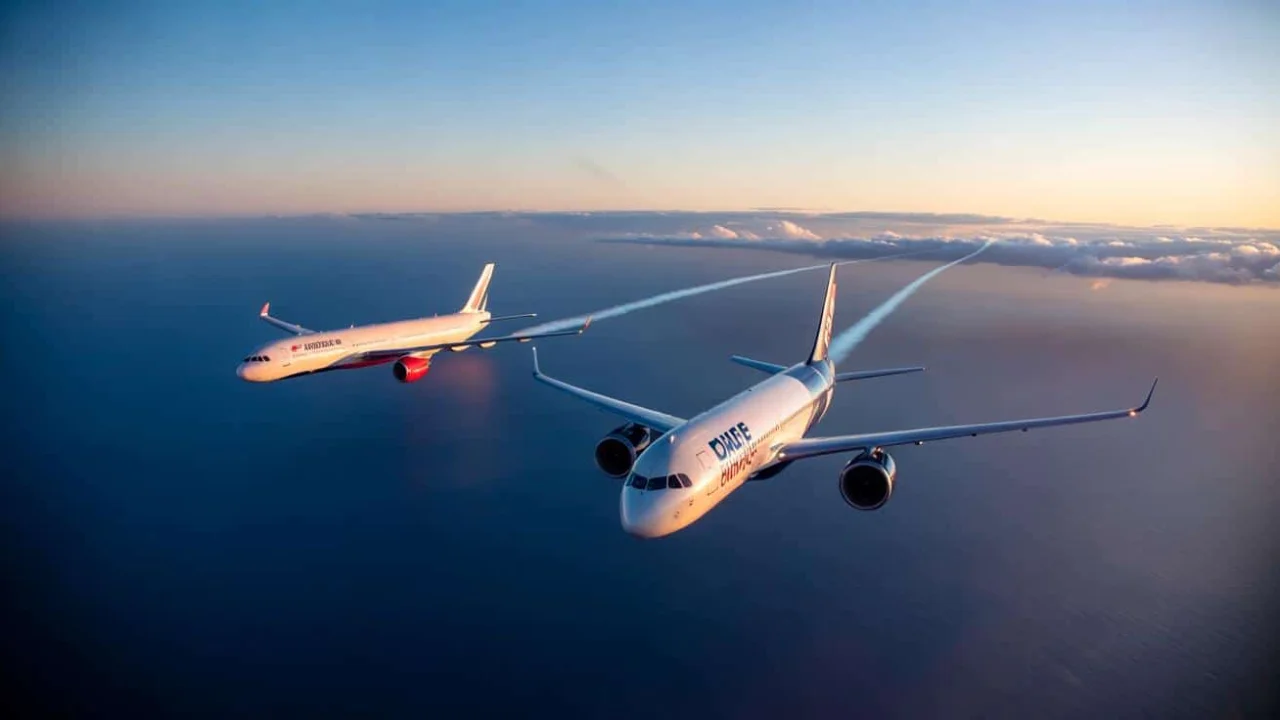
High above the Atlantic Ocean in late 2025, aviation history quietly unfolded as two commercial airliners achieved something previously thought impossible. Multiple airlines including Air France, Delta, Virgin Atlantic, and French bee successfully demonstrated coordinated flight operations that could revolutionize fuel consumption across the industry.
The breakthrough centers on wake energy retrieval, a concept borrowed from migrating birds that fly in V-formations to reduce energy expenditure. When applied to commercial aviation, this technique allows a trailing aircraft to position itself within the aerodynamic wake of a leading aircraft, capturing upward-moving air currents that reduce required engine thrust.
| Operation Component | Current Achievement | Next Development Phase |
|---|---|---|
| Rendezvous Coordination | Successfully validated in 8 test flights | Formation flight testing |
| Safety Compliance | Full adherence to existing separation rules | New formation flight protocols |
| Fuel Savings Potential | Up to 5% reduction projected | Real-world measurement trials |
| Air Traffic Integration | Coordinated across multiple control centers | Automated pairing systems |
Airlines Racing to Implement Revolutionary Flight Pairing Systems
The participating carriers represent a cross-section of international aviation, each bringing unique operational perspectives to the trials. Air France leveraged its extensive transatlantic network, while Delta contributed its advanced flight operations technology. Virgin Atlantic provided expertise in premium passenger service integration, and French bee offered insights from leisure travel route optimization.
- Air France: Integrated pairing protocols with existing hub-and-spoke operations
- Delta Air Lines: Applied advanced operational research to trajectory optimization
- Virgin Atlantic: Focused on passenger comfort during formation transitions
- French bee: Tested cost-benefit analysis for leisure route applications
Massive Environmental Impact Projected Across Global Aviation Networks
Industry calculations suggest transformative potential for emissions reduction. A 5% fuel burn decrease across major transatlantic routes could eliminate thousands of tonnes of jet fuel consumption annually. For heavily traveled corridors like London-New York or Paris-Miami, such reductions translate to measurable environmental benefits without requiring new aircraft designs or engine technologies.
- Emissions Reduction: 2-3% of global CO₂ from aviation could be significantly reduced
- Fuel Savings: 1-2 tonnes per intercontinental flight depending on aircraft type
- Cost Benefits: Operational savings without capital equipment investment
- Route Optimization: Enhanced efficiency across existing flight path networks
“The digital precision required for this operation exceeds anything we’ve attempted in commercial aviation,” explains a flight operations specialist. “The Pairing Assistance Tool processes real-time data from multiple aircraft simultaneously while coordinating with air traffic controllers across different countries.”
Advanced Software Coordinates Complex Multi-Aircraft Operations
The Pairing Assistance Tool (PAT) developed by Airbus functions as a sophisticated coordination system, continuously calculating optimal trajectories for aircraft convergence. This software analyzes position data, speed variations, weather conditions, and air traffic patterns to propose precise meeting points in three-dimensional space.
Flight crews maintain complete authority over their aircraft while receiving algorithmic suggestions for route adjustments. Controllers from Ireland’s AirNav Ireland, France’s DSNA, the UK’s NATS, and EUROCONTROL collaborate through dedicated interfaces to approve trajectory modifications without disrupting standard traffic flows.
| Performance Metric | Achievement Level | Industry Impact |
|---|---|---|
| Rendezvous Accuracy | Same point, altitude, and time | Enables formation flight operations |
| Safety Compliance | 100% adherence to separation rules | Maintains existing safety standards |
| Multi-Country Coordination | 4 air traffic control systems | Proves international feasibility |
| Test Flights Completed | 8 successful operations | Validates operational procedures |
Pilots and Controllers Adapt to Unprecedented Coordination Requirements
The operational trials introduced new protocols requiring enhanced communication between flight crews, dispatch teams, and air traffic controllers. Pilots must interpret system-generated suggestions while maintaining awareness of a partner aircraft they may never visually observe, particularly during nighttime or cloud-covered flights.
Controllers face the challenge of maintaining standard vertical separation while positioning aircraft for potential formation segments. The breakthrough demonstrates that such precise coordination can occur within routine air traffic conditions rather than requiring specially protected airspace.
Each successful rendezvous required four critical steps: real-time computation of optimal trajectories, joint assessment by operations centers and controllers, flight plan adjustments coordinated between aircraft, and cockpit commitment functions activated by both crews simultaneously.
“This represents just the beginning of a longer journey toward operational wake energy retrieval,” notes a regulatory affairs expert. “The next phase involves actual formation flying, where we’ll measure real fuel savings and assess any passenger comfort implications.”
Commercial Aviation Prepares for Fundamental Operational Transformation
The successful rendezvous trials establish the foundation for subsequent phases involving actual formation flight. Future testing will position trailing aircraft within the precise aerodynamic sweet spot where upward-moving air provides additional lift, requiring less engine thrust and reducing fuel consumption.
Engineers will measure actual fuel savings, monitor engine performance parameters, and evaluate passenger comfort during formation transitions. The concept requires trailing aircraft to maintain carefully calculated positions slightly off-center from the lead aircraft, utilizing upward air currents while avoiding dangerous turbulence zones.
For passengers, future formation flights would likely remain imperceptible except for possible glimpses of partner aircraft maintaining steady relative positions. Airlines could market reduced environmental impact while regulators count measurable emission reductions across major route networks.
Frequently Asked Questions
How close do aircraft fly during wake energy retrieval operations?
Aircraft maintain safe separation distances while positioning to benefit from aerodynamic effects, not direct formation flying.
Will passengers notice when their flight uses wake energy retrieval?
Formation transitions occur gradually under autopilot control, making them virtually imperceptible to passengers.
Which routes benefit most from this fuel-saving technology?
Long-haul oceanic routes show greatest potential due to sustained cruise phases and high fuel consumption.
How much fuel can airlines save using this technology?
Initial projections suggest up to 5% fuel reduction per flight, saving 1-2 tonnes on intercontinental routes.
When will wake energy retrieval become commercially available?
Implementation depends on completing formation flight testing and obtaining regulatory approval from aviation authorities.
Do pilots require special training for coordinated flight operations?
New procedures require training in enhanced coordination protocols and digital assistance tool operation.
Industry Experts Anticipate Widespread Implementation Timeline
The successful Atlantic trials position wake energy retrieval alongside other sustainability initiatives including sustainable aviation fuels, advanced engine technologies, and lightweight airframe materials. European programs like SESAR fund related research involving competitors including Boeing, research institutes, and air navigation providers across multiple countries.
Commercial implementation requires establishing global standards rather than regional experiments, ensuring consistent procedures across international airspace. The coordination between multiple air traffic control systems during the 2025 trials demonstrates feasibility for worldwide adoption.
Aviation’s contribution to global CO₂ emissions, approximately 2-3% of the total, faces increasing regulatory pressure for reduction. Wake energy retrieval offers measurable improvements without requiring new aircraft purchases or engine modifications, making it attractive for airlines managing capital expenditure constraints.
“These trials prove that precision coordination between independent commercial flights can be achieved safely and reliably under normal operating conditions,” concludes an aerospace engineering consultant. “We’re witnessing the emergence of truly collaborative flight operations that will define aviation’s sustainable future.”