
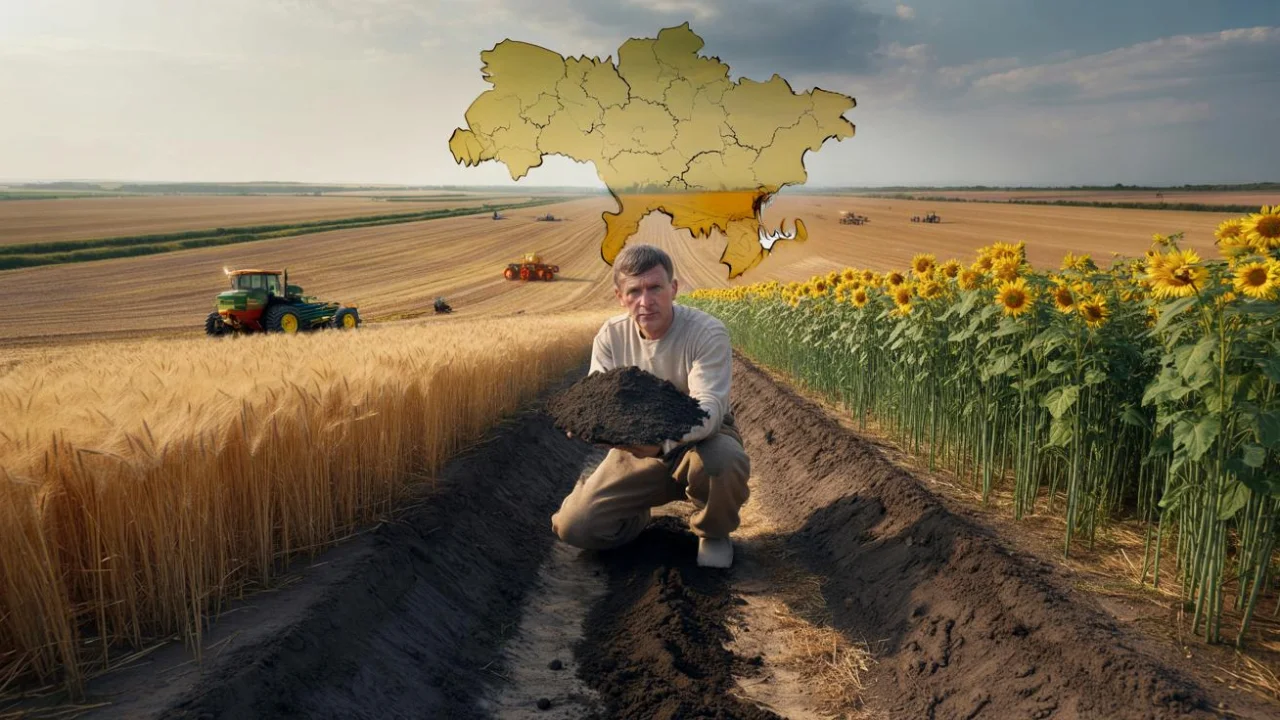
On a late summer afternoon near Poltava, in central Ukraine, a farmer digs his boot heel into a field that looks almost unreal. The soil comes up in thick, inky clods, soft as cake and dense as chocolate fudge. In his palm, it crumbles slowly, staining his fingers a deep, smoky black. He laughs and calls it “our oil, but better.” No pump jacks on the horizon here. Just wheat, sunflowers, and an endless ocean of dark earth.
The smell is sweet and damp, like a forest after rain. A tractor crawls across the horizon, throwing up a low dust that isn’t really dust at all, more like powdered life. This is chernozem soil, the “black gold of agriculture,” and people around here talk about it the way others talk about family inheritance or winning lottery tickets. Under your feet, the ground is quietly worth fighting for.
This remarkable soil formation has transformed vast swaths of Eastern Europe and Central Asia into one of the world’s most strategically important agricultural regions. With layers reaching up to one meter deep, chernozem soil represents nature’s most generous gift to humanity—a foundation upon which entire nations have built their economic and geopolitical power.
The geopolitical implications of this black earth extend far beyond agriculture. When tensions rise and trade routes shift, the countries blessed with chernozem deposits suddenly find themselves holding cards that can feed nations or starve them. This soil doesn’t just grow crops; it grows influence, leverage, and the kind of soft power that can reshape international relations with a single harvest decision.
The Silent Power of a Black Soil Belt
Stretching like a dark ribbon across Eastern Europe and into Central Asia, the chernozem belt looks almost modest on a map. Just a band of darker shading from eastern Ukraine through Russia’s southern steppe to northern Kazakhstan. On the ground, though, it feels like walking across the battery pack of the world’s food system. The top layer of this soil can go down 60, 80, sometimes 100 centimeters, almost pure black.
Scientists measure its humus content at up to 15%. Farmers just say: you drop a seed in, and something grows. On the outskirts of Kharkiv, an agronomist once dug a pit for visiting journalists. He stepped into the trench until the soil reached his waist and ran his hand along the vertical wall of pure black. No rocks, no pale sand streaks, no tired clay. Just a solid column of fertile darkness.
“This soil is like a bank account that’s been earning compound interest for 10,000 years. Every handful contains more organic matter than most farmers see in their entire fields elsewhere in the world.”
— Dr. Sergey Volkov, Soil Scientist at Moscow Agricultural Academy
He joked that in some Western fields, you hit subsoil after one spade. Here, you could bury a child standing up and they’d still be in topsoil. That same field, planted mostly with wheat and sunflowers, can produce yields that would make many European farmers stare. And it does it with fewer inputs, less fertilizer, and a margin of luck that feels almost unfair.
Formation and Characteristics of Earth’s Most Fertile Soil
Chernozem soil didn’t just appear overnight. Over thousands of years, grasses grew and died on the Eurasian steppe, their roots threading deep, their remains building layer after layer of organic matter. Winters were cold, summers were hot, and the rhythm of dry and wet locked carbon into the ground.
| Characteristic | Chernozem Values | Typical Agricultural Soil |
|---|---|---|
| Organic Matter Content | 10-15% | 2-4% |
| Humus Layer Depth | 60-100 cm | 15-30 cm |
| pH Level | 6.5-7.5 (neutral) | 5.5-6.5 (slightly acidic) |
| Water Holding Capacity | 35-40% | 20-25% |
| Nitrogen Content | 0.4-0.6% | 0.1-0.2% |
Microscopic life went to work, transforming dead plants into a rich sponge that holds water and nutrients like a vault. This slow geological patience gave Ukraine, Russia, and Kazakhstan a hidden advantage: land where nature did much of the work that fertilizers and irrigation try to imitate elsewhere.
Key Advantages of Chernozem Agriculture
The unique properties of chernozem soil create agricultural advantages that are difficult to replicate artificially:
- Natural Fertility: High organic matter content provides sustained nutrient release without heavy fertilization
- Water Retention: Superior moisture-holding capacity reduces irrigation requirements
- Structural Stability: Excellent soil structure prevents erosion and compaction
- pH Balance: Neutral pH levels optimize nutrient availability for crops
- Deep Root Zone: Thick fertile layer allows extensive root development
- Microbial Activity: Rich ecosystem supports beneficial soil organisms
- Temperature Regulation: Dark color absorbs heat, extending growing seasons
- Carbon Storage: Massive carbon sequestration capabilities support environmental benefits
From Quiet Fields to Global Breadbasket and Leverage
Walk into a Ukrainian grain terminal on the Black Sea and you can feel how this soil turns into power. Trains roll in, wagons stacked with golden wheat and corn, all grown on those dark fields hundreds of kilometers inland. Elevators roar as grain pours into silos, destined for North Africa, the Middle East, and parts of Asia where local harvests simply can’t meet demand. This is what people mean when they call the region a breadbasket.
“When you control the chernozem, you control food security for half the world. It’s not just about agriculture—it’s about geopolitical stability and the power to influence entire regions through grain exports.”
— Maria Kolesnikova, Agricultural Policy Analyst at the International Food Policy Research Institute
The numbers tell the story of this agricultural dominance. Ukraine alone, before recent conflicts, was the world’s fourth-largest grain exporter. Russia consistently ranks among the top three wheat exporters globally. Kazakhstan has emerged as a major player in wheat markets, particularly serving Central Asian and Middle Eastern countries.
Economic Impact and Global Food Security
The economic implications of chernozem extend far beyond individual farms or even national borders. This soil foundation supports entire economies:
- Export Revenue: Grain exports generate billions in foreign currency annually
- Employment: Agricultural sectors employ millions across the chernozem region
- Food Security: Supplies grain to over 50 countries worldwide
- Price Stability: Acts as a buffer against global food price volatility
- Rural Development: Supports infrastructure and communities in agricultural areas
- Processing Industries: Feeds downstream food processing and manufacturing
Recent global events have highlighted just how critical this soil resource has become. When supply chains from chernozem regions are disrupted, grain prices spike worldwide, bread becomes more expensive in Cairo, and food riots threaten governments thousands of miles away from the black fields of Eastern Europe.
Environmental Significance and Climate Impact
Beyond its agricultural value, chernozem soil plays a crucial role in global environmental systems. These soils represent one of Earth’s largest terrestrial carbon sinks, storing massive amounts of carbon that would otherwise contribute to atmospheric CO2 levels.
“Chernozem soils contain three times more carbon per hectare than tropical rainforests. They’re not just feeding the world—they’re helping stabilize our climate by keeping billions of tons of carbon locked underground.”
— Dr. Elena Mikhailova, Environmental Soil Scientist at Clemson University
The conservation of these soils has become a global priority, not just for agricultural sustainability but for climate change mitigation. Proper management practices can enhance their carbon storage capacity while maintaining their legendary fertility for future generations.
Challenges and Threats
Despite their remarkable resilience, chernozem soils face several serious challenges in the modern era:
- Climate Change: Altered precipitation patterns and temperature extremes
- Intensive Agriculture: Over-cultivation reducing organic matter content
- Erosion: Wind and water erosion removing precious topsoil
- Urbanization: Development converting agricultural land to other uses
- Chemical Degradation: Excessive fertilizer and pesticide use altering soil chemistry
- Compaction: Heavy machinery damaging soil structure
- Conflict: Military activities disrupting agricultural systems
Frequently Asked Questions
What makes chernozem soil so fertile compared to other soils?
Chernozem contains 10-15% organic matter versus 2-4% in typical soils, plus superior water retention and nutrient availability.
How deep are chernozem soil layers?
The fertile black layer typically extends 60-100 centimeters deep, sometimes reaching over one meter in depth.
Which countries have the most chernozem soil?
Ukraine, Russia, and Kazakhstan contain the largest chernozem deposits, with smaller areas in Romania, Moldova, and Argentina.
Can chernozem soil be artificially created or replicated?
No current technology can replicate chernozem’s unique formation process that took thousands of years to develop naturally.
How does chernozem soil affect global food prices?
Supply disruptions from chernozem regions cause immediate spikes in global grain prices due to limited alternative sources.
Is chernozem soil sustainable for long-term agriculture?
Yes, with proper management practices chernozem can maintain fertility indefinitely, but requires careful conservation to prevent degradation.
The future of global food security may well depend on how humanity chooses to steward these remarkable soils. As populations grow and climate patterns shift, the black fields of Eastern Europe and Central Asia will likely become even more precious. The farmer near Poltava who called his soil “our oil, but better” understood something that agricultural economists and geopolitical strategists are only beginning to fully appreciate: in a world of increasing scarcity, the deepest wealth may lie not in what we extract from the earth, but in what the earth itself has already given us.